
Have you ever found yourself thinking, “Why am I still in the same place?”
Maybe you have a goal you've been thinking about for months. You want to become healthier, more confident, financially secure, productive, successful, or simply happier with your everyday life.
You know what you want. You may even think about it regularly. But somehow, nothing seems to change.
It's frustrating when you feel as though you're putting in effort but aren't moving forward. Yet sometimes the most important question isn't “Why hasn't my life changed?” What you should be asking yourself is “What can I do differently?”
Because if we continue making the same choices, following the same patterns and repeating the same habits, we shouldn't be surprised when we continue experiencing similar results.
Nothing changes if nothing changes.
And while that statement may sound simple, it can be a powerful starting point for personal growth.

Wanting Change Isn't the Same as Creating Change
Most of us have things we'd like to improve.
We might want to:
- Become more confident
- Improve our health
- Develop better habits
- Save more money
- Start a business
- Learn a new skill
- Strengthen our relationships
- Become more organised
- Stop procrastinating
- Improve our mindset
- Feel happier and more fulfilled
There is nothing wrong with wanting these things.
The problem begins when wanting becomes the end of the process rather than the beginning.
You can dream about becoming healthier, but eventually you have to make different choices about food, movement, sleep and your daily routine.
You can dream about financial freedom, but eventually you have to examine your spending, saving and earning habits.
You can want better grades, but eventually you need to change how you study.
You can wish for greater confidence, but eventually you have to give yourself opportunities to speak up, try something new and do things that make you slightly uncomfortable.
Dreams provide direction.

Why We Often Stay Stuck
If change can improve our lives, why don't we simply change?
Because familiarity is comfortable, even when it isn't making us happy.
We know our routines.
We know our habits.
We know what to expect.
Trying something different introduces uncertainty.
What if we fail?
What if people judge us?
What if we discover we're not as good at something as we hoped?
What if our efforts don't produce immediate results?
These questions can keep us exactly where we are.
Sometimes we don't need more motivation.
We need to become willing to experience a little discomfort in exchange for growth.
Action creates movement
Your Daily Choices Are Creating Your Results
This doesn't mean every result in life is completely within our control. Circumstances, opportunities, other people's decisions and unexpected events can all influence what happens to us.
But there is an area we can influence:
What we choose to do next.
Your daily habits may seem insignificant because individual actions are often small.
One healthy meal doesn't transform your health.
One workout doesn't make you fit.
One page of a book doesn't make you an expert.
One pound saved doesn't create financial independence.
One positive affirmation doesn't completely transform your mindset.
But repeated actions can become habits, and habits can gradually change the direction of your life.
Think of it like steering a car.
A tiny change in direction might not seem important when you're travelling a short distance. But over a much longer journey, that small adjustment can take you somewhere completely different.
Your everyday choices work in much the same way.
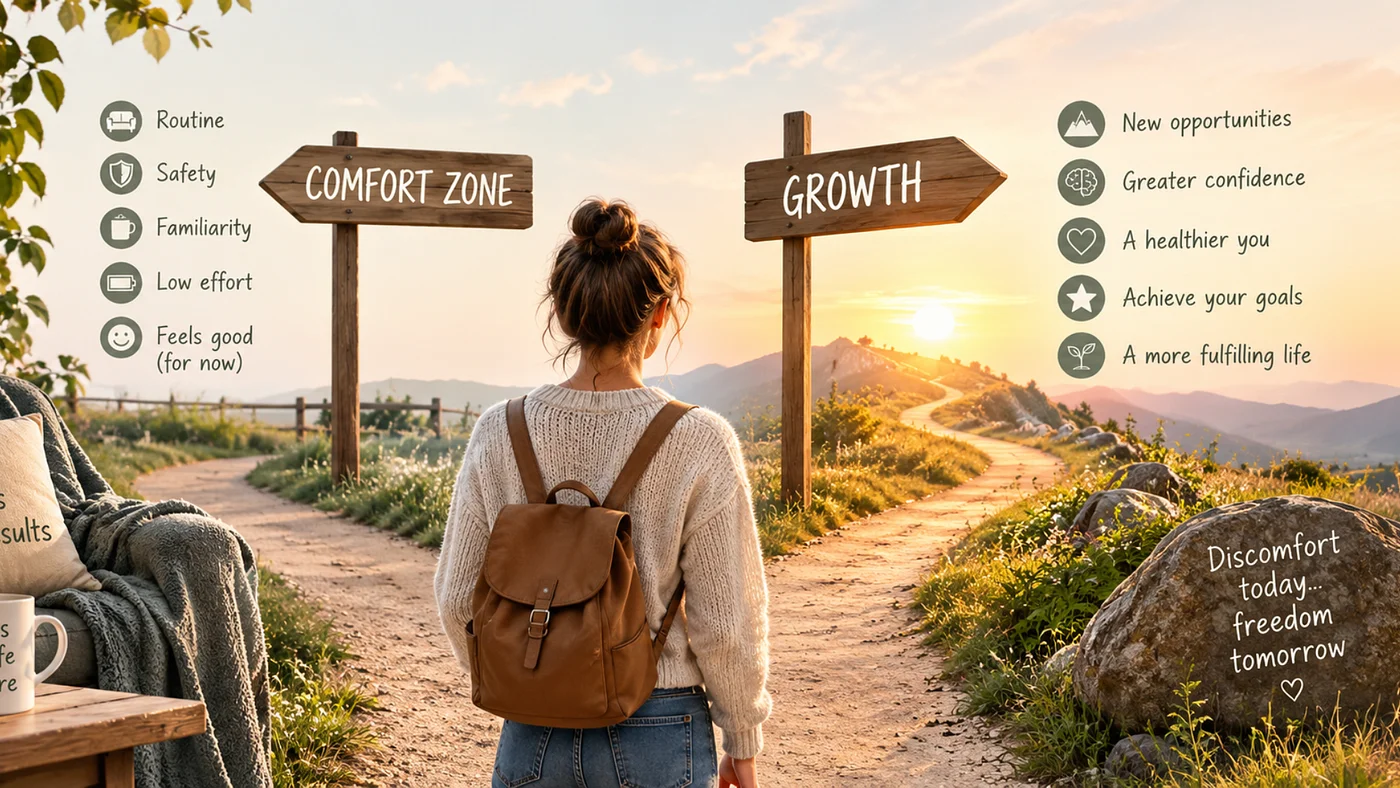
The Comfort Zone Can Become a Comfort Trap
Your comfort zone isn't necessarily a bad thing.
Rest, familiarity and routine are important.
The problem occurs when comfort prevents you from doing something that could genuinely improve your life.
- You might stay quiet because speaking up feels uncomfortable.
- You might avoid applying for an opportunity because rejection feels uncomfortable.
- You might postpone starting a project because you're afraid it won't be perfect.
- You might continue an unhealthy habit because changing it requires effort.
Eventually, avoiding discomfort can create another type of discomfort: regret.
There is the discomfort of trying something new. And then there is the discomfort of wondering what might have happened if you had tried.
Sometimes the first step toward personal development is simply deciding which discomfort you're willing to choose.
You Don't Have to Change Everything at Once
One of the biggest mistakes people make when trying to improve themselves is attempting to change their entire life overnight.
Monday arrives and suddenly they decide:
"I'm going to exercise every day, eat perfectly, wake up at 5 a.m., meditate, read for an hour, start my business, save half my income and completely transform my mindset!"
By Wednesday, they're exhausted, and by Friday, the old routine has returned.
Real personal growth doesn't have to look dramatic.
Start Smaller
- Instead of exercising for an hour, take a 10-minute walk.
- Instead of completely changing your diet, make one healthier meal.
- Instead of writing an entire book, write one page.
- Instead of spending hours learning a new skill, dedicate 10 minutes to it.
- Instead of trying to become incredibly confident overnight, challenge yourself to speak up once.
Small doesn't mean insignificant. Small means manageable. And manageable actions are much easier to repeat.
Use Affirmations to Support the Change
This is where affirmations can become a useful part of your self-improvement routine.
An affirmation isn't a magic sentence that changes your circumstances simply because you repeat it.
Instead, a thoughtfully written affirmation can help you deliberately focus your attention on a belief, quality or behaviour you want to strengthen.
For example, instead of simply saying:
“I am successful.”
you could create an affirmation that connects more directly with action:
“I take consistent steps toward the life I want, even when progress feels slow.”
Or:
“I am capable of changing my habits one choice at a time.”
Or:
“I don't need to change everything today. I only need to take the next positive step.”
These statements can serve as reminders of the behaviour you're trying to develop.
The real power comes from connecting the affirmation to action.
Say the affirmation.
Then ask yourself:
“What can I do today that supports this belief?”
That's where mindset and behaviour begin working together.
The One-Change Rule
If you're feeling stuck, try this simple exercise.
Don't attempt to fix everything. Choose one area of your life.
Ask yourself:
What is one thing I could change that would move me closer to the person I want to become?
Maybe it's:
- Going to bed 30 minutes earlier
- Drinking more water
- Spending less time scrolling
- Saving a small amount of money
- Taking a daily walk
- Reading for 10 minutes
- Practising a new skill
- Writing in a journal
- Saying no when you genuinely don't want to do something
- Speaking more kindly to yourself
- Repeating a positive affirmation each morning
Then make that one change consistently.
You may be surprised by what happens when a small action becomes a repeated behaviour.
Don't Wait Until You Feel Ready
One of the biggest obstacles to change is waiting for the perfect moment.
"I'll start when I'm more motivated."
"I'll do it when I have more time."
"I'll begin when I feel confident."
"I'll start next Monday."
But motivation isn't always there before action. Sometimes action creates motivation.
- You take the first step.
- You notice a little progress.
- That progress gives you encouragement.
- You take another step.
Gradually, something that once felt difficult starts becoming normal.
You don't have to feel completely ready. You just need to be willing to begin.
What If You Fail?
You probably will.
Not because you're incapable of changing, but because setbacks are a normal part of learning new behaviours.
- You might miss a workout.
- Break your budget.
- Skip your affirmation routine.
- Procrastinate.
- Lose motivation.
- Return to an old habit.
That doesn't mean you've failed completely. It means you're human.
Instead of asking:
“Why can't I stick to anything?”
try asking:
“What can I learn from what happened, and what can I do differently tomorrow?”
Self-improvement isn't about creating a perfect version of yourself.
It's about becoming more aware, making better choices and continuing to move forward.

Your Future Is Built Through Ordinary Days
Transformation can sound dramatic.
We imagine huge breakthroughs and life-changing moments.
But much of personal growth happens quietly.
It's choosing the healthier option when nobody is watching.
It's spending ten minutes learning instead of scrolling.
It's getting back up after a disappointing day.
It's having the difficult conversation.
It's keeping a promise you made to yourself.
It's replacing one negative thought with a more constructive one.
It's taking another small step when you can't yet see the destination.
Your life isn't only shaped by the big decisions you make occasionally. It's also shaped by the small decisions you make repeatedly.
Ask Yourself: What Needs to Change?
If you've been feeling stuck, take a moment to reflect.
Ask yourself:
What do I want to be different six months from now?
Then ask:
What am I currently doing that is helping me get there?
And perhaps the most important question:
What am I doing that is keeping me where I am?
You don't need to judge yourself for the answers. Use them as information. Awareness gives you the opportunity to make a different choice. And that different choice could be the beginning of something new.
Nothing Changes If Nothing Changes
You don't have to transform your entire life today. You don't need a perfect plan and you don't need unlimited motivation.
You don't even need to know exactly where the journey will take you. You simply need to identify one thing you can do differently. Then do it!
Then tomorrow, guess what, you do it again. Adjust when necessary and learn from any setbacks. But just keep going!
Because sometimes the biggest transformation begins with one very ordinary decision:
“I'm going to do something differently today.”
And that is where change begins.
Nothing changes if nothing changes. But when you change your choices, your habits and your actions, you give yourself the opportunity to create a different future.
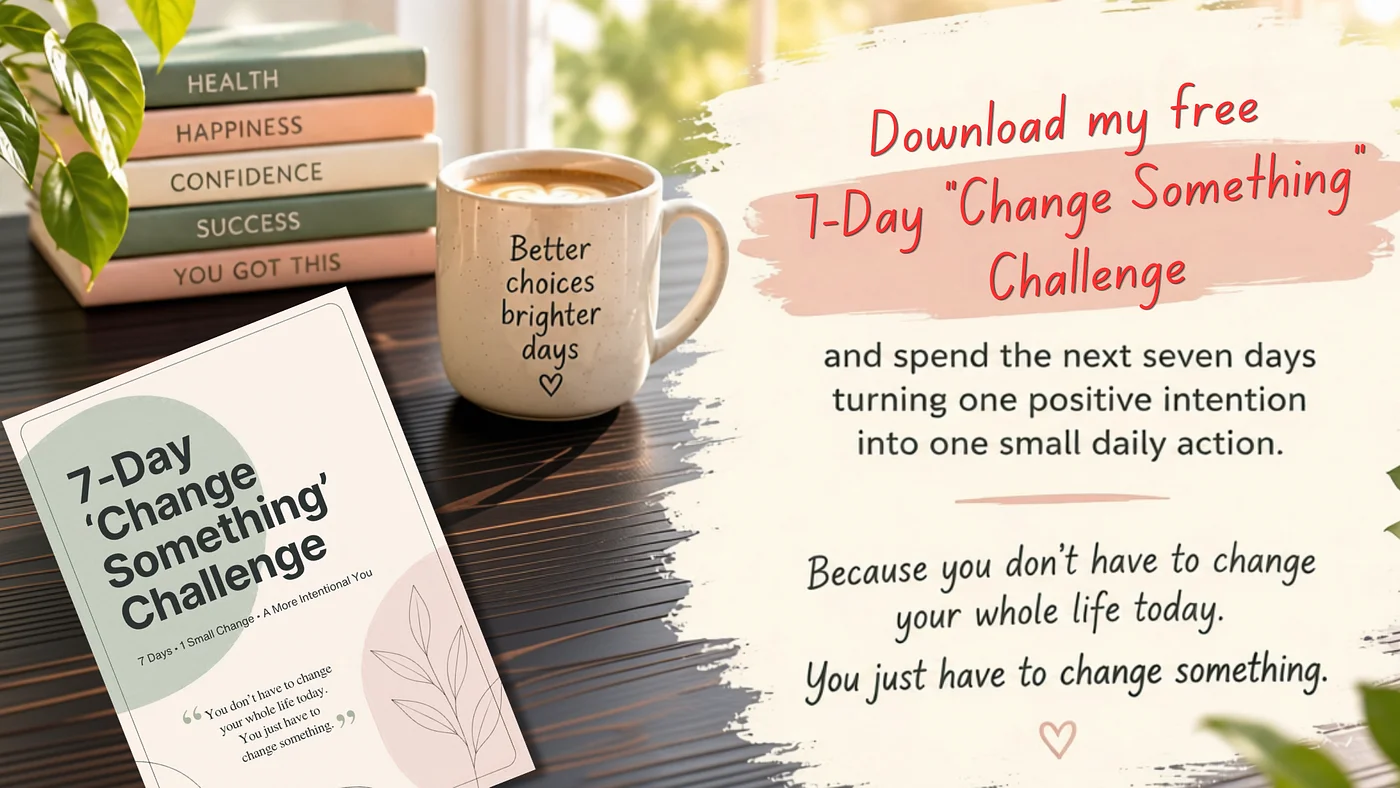
Ready to stop waiting for change and start creating it?
Download my free 7-Day “Change Something” Challenge and spend the next seven days turning one positive intention into one small daily action.
7 Days. 1 Small Change. A More Intentional You.
The workbook includes:
1 – My Change
- What area of my life do I want to improve?
- Why is this important to me?
- How would my life look different if I made this change?
2 – My Affirmation
Create your own personalised affirmation using a simple formula:
3 – My Daily Action
Steps for you to take daily action
4 – My Reflection
Questions to help you reflect and plan your next steps
Because you don't have to change your whole life today. You just have to change something.